
Highway Expansion
The drive to keep reliving regrettable history

US Highway 74 will get you to Charlotte from Murphy, the westernmost town in the state, or from Wrightsville Beach, on the edge of the continent. Most of the way from one end of North Carolina to the other will be smooth sailing. The city of Charlotte, though, is a chokepoint for people traveling through, or at least it was. Into the 1940s, the city was relatively dense, which made for an annoyance for drivers. For the miles from the western edge of the city to the eastern edge, a driver would encounter block after block of stoplights, delivery trucks, pedestrians, crosswalks, and slow progress. The freedom of speed came to a halt in town. In response to this experience, Americans in the 1940s were quickly adapting their cities to automobiles and their odd promise of urbanism without density.
High speeds require wide boulevards, at the least. The highest speeds need controlled access and broad swaths of land that reshape everything around them. And to build a big road, you need a pile of money.
The Federal-Aid Highway Act of 1944 provided the funding, to the tune of $1.5 billion (in 1944 dollars). President Roosevelt signed the Act into law in July; by August, Charlotte announced a new, wide Boulevard to cut across town and reduce travel times.
But you can’t just build a big ol’ road anywhere. A whole bunch of stuff is gonna be in the way. And nobody wants an express route to cut up their backyard, or their place of business, or their church, much less to land on top of it altogether. Many people think they want the road nearby. But not too close. Routing is where power comes in. The formula is simple: the people with the least power get the highway routed through their neighborhood.
Charlotte Mayor and Myers Park Country Club president Herbert Baxter [fn: the most Charlotte of things] knew how to utilize power. He had lined up support before announcing the project, and did so again prior to confirming the route. The highway–to be called Independence Boulevard–would cut through the southern edge of downtown, through historic Black communities Third Ward and Brooklyn. It would carve out a chunk of the Cherry neighborhood, also Black, and from there “swerve abruptly northeastward to miss Myers Park and surrounding upper-income neighborhoods. Instead, it ran across Elizabeth Avenue, through Independence Park, and northeastward out of the city via the middle-class [and white] Chantilly district.”1 There was outcry from those places and people whose lives would be upended by the new route, but the matter had already been decided behind closed doors. Tom Hanchett cites Charlotte historian Dan Morrill: “[City Council] gathered on October 6, 1946, for an informal meeting at the Myers Park Country Club, where Mayor Baxter was President. There they endorsed…the route through Chantilly.”2
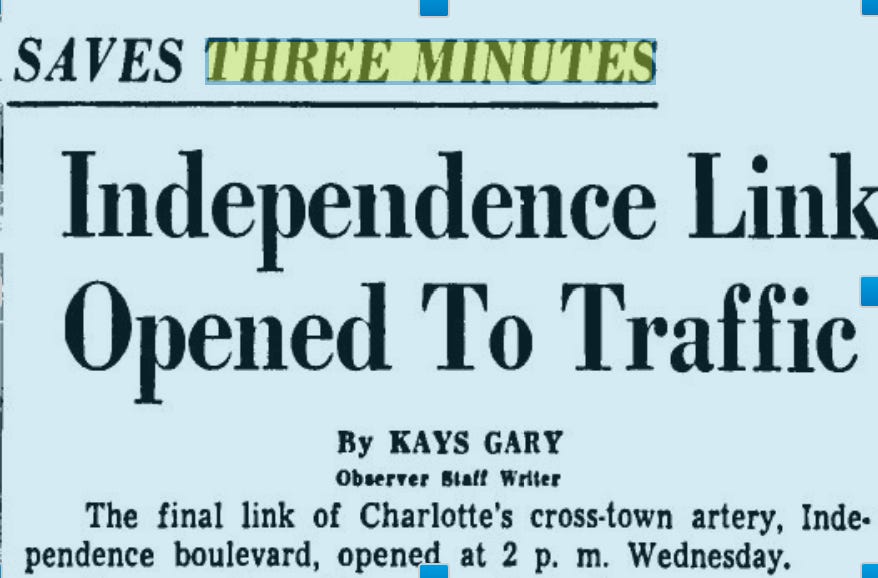
The road opened in 1949, but ongoing construction continued to make it faster through 1955. When it was finally complete, Charlotte Observer reporter Kays Gary went out to see the results. He and a colleague drove west to east on the the old streets; they drove back east to west on the new highway. “Saves three minutes,” he reported.
Nothing ever dies in this world. Everything returns in new form. Including bad ideas. This time the bad idea is about a different stretch of urban highway. Interstate 77 skirts the western edge of downtown Charlotte. The powers routed it through yet another series of politically powerless, historically Black neighborhoods. It has occasionally been expanded and now includes as many as twelve lanes in the 3.5 miles from Lasalle Street to Remount Road. As urban highways do, it chews up huge areas of land. It cuts off neighborhoods from one another. It restricts movement from place to place, and movement is the life of a city.
And, as highways do, it attracts traffic. For significant portions of the day, the interstate moves well below the posted speed, because of the large number of lanes.3 We’re nearly a century into a terrible imbalance of tax dollars going to one mode of transportation–the private automobile. All that history has accumulated–Charlotte is a challenge to get around without a car. New money keeps going to building more lanes, and the traffic keeps getting worse.
The North Carolina Department of Transportation has a plan now to add lanes to the I-77. It’s a plan that won’t work, as our neighbors 200 miles down I-85 can attest:
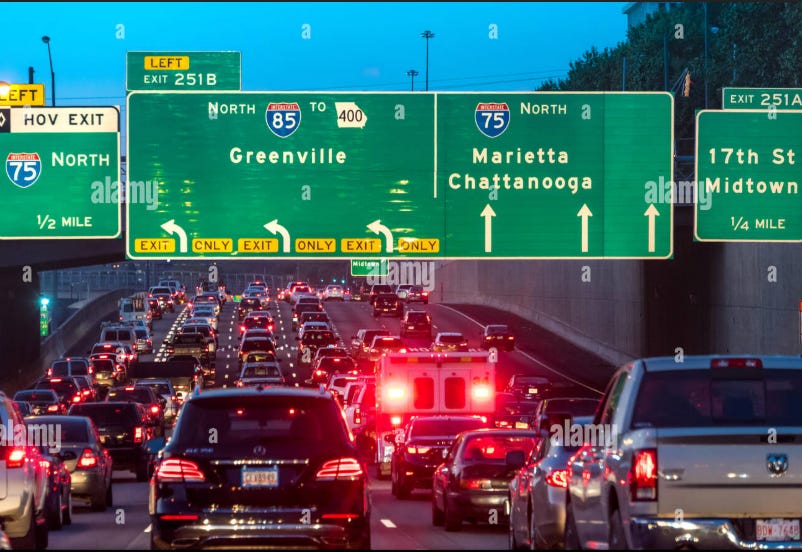
Fortunately, it will only cost $4.3 billion dollars.
If that sounds bad, well, it keeps getting worse. The novel idea is to add elevated toll lanes to the highway without significantly altering its other lane capacity. The state won’t widen the road (which wouldn’t work, but seems like it would) or create alternatives while narrowing the road or eliminating it altogether (which would work, but seems like it wouldn’t). Instead, commuters with enough money will be able to drive above traffic, literally buying their way out of congestion. Regular folks will sit in the shadows of the so-called “Lexus Lanes.”
The toll lanes will be managed by a private company, which will keep a nice chunk of the money. And by “manage,” I mean that the company will raise the tolls in accordance with congestion levels. The worse the traffic, the higher the toll. The goal is to charge high enough prices to have free-flowing toll lanes above without regard to congestion below.
The routing? That’s where the power comes in. The situation is different now than with Mayor Baxter’s. Then, the city’s elite could simply decree a route and then set about building the project. The current situation requires a more deft touch in the exercise of power. Our west side neighborhoods have built enough real, durable power over the decades that we cannot be run over without at least a facade of community input.
In public meetings, NCDOT exercised their power by designing a question to help them get the answer they wanted, rather than to get real collaboration with the people who will have to live with this highway. “Would you prefer a widened highway with a much larger footprint, or elevated toll lanes with a smaller footprint?” they asked.
Would you prefer to drink this hemlock or to swallow this cyanide capsule?
The results are the same: a rupture without a solution. Years of pain but no healing. The Department of Transportation could be part of stitching the city back together.
To summarize:
the state will spend several billion dollars of public money to construct what are, in effect, private lanes;
A private company will operate and profit from those lanes for the next 50 years or so;
The lanes will have little to no effect on traffic, and do not intend to do so;
The project will compound, rather than relieve, the racist history of urban highways, including Interstate 77.
What to do? If you’re in Charlotte, there is still time to stop this project, but not much. Here are a few steps to take quickly:
The Charlotte Regional Transportation Planning Organization (CRTPO) meets Wednesday, February 18 at 6pm, Room 267 in the government center. They can stop this project most directly before it is fully placed in the hands of state government. The chair of CRTPO is Brad Richardson, who can be reached at brichardson@stallingsnc.org. Contact him–be direct but kind when you do so.
Charlotte city councilors have heard the outcry from affected communities. They need to reverse a decision from two years ago that allowed study of highway expansion to move forward. Email and call them.
All of this is moving on a short timeline. If you’re inclined to take action, do so today.
Further information from Sustain Charlotte is here.
Recent Podcast appearance: My new friend Ross Kane teaches theology and ethics at Virginia Theological Seminary. He’s also a saxophone player. We’re obviously kin.
We recently had a fascinating conversation which went in unpredictable directions. Here’s a Spotify link and an Apple podcast link. His Love Your Neighbor podcast has numerous other interviews, including a fascinating one about VTS’s reparations commission.
One Last Note: I’ve been listening to Clark Terry lately. He swings harder than anybody. Here’s a classic track from 1957, which has an obvious nod to the growing Civil Rights Movement.
The quote is from Thomas Hanchett’s Sorting Out the New South City: Race, Class, and Urban Development in Charlotte, 1875-1975, 2nd ed. (Chapel Hill: UNC Press, 2020) 239-40. Hanchett’s work, for local folks, is essential to understanding Charlotte. He’s also an excellent human and a fine fiddle player. I’m glad to call him a friend.
Hanchett, Sorting Out, 240. The original quote from Morrill comes from a Parade magazine in 1988.
This concept is called “induced demand.” In short, people use what’s available to them. If you build for more cars, you get more cars. If you build for more transit options, you get more transit riders.
Nice history lesson and informative article, Gregg. Thank you.